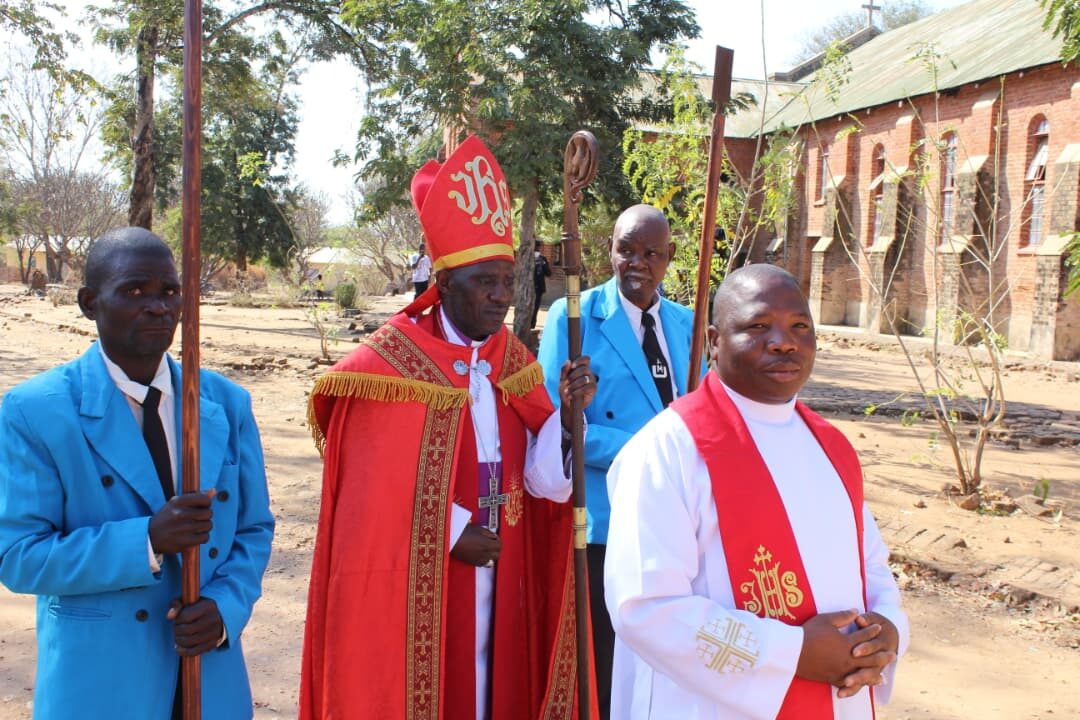
The Rt. Rev. Dennis Milanzi
Bishop of Eastern Zambia
Third and incumbent Bishop
Bishop Dennis Milanzi leads the Diocese in its ministry of worship, mission, social development and enterprise across the Eastern Province.
About
The history of the Anglican Diocese of Eastern Zambia (ADEZ) must be understood at two levels. As an independent diocese, Eastern Zambia dates from 1995; however, its Anglican roots reach back to the beginning of organised Anglican mission in Zambia in the early twentieth century. Msoro, in present-day Mambwe District, is the historic cradle of Anglicanism in Eastern Zambia and one of the earliest centres of Anglican mission in the country. 1. The beginnings of Anglican mission in Eastern Zambia Anglican missionary work in the territory then known as Northern Rhodesia developed through the Universities’ Mission to Central Africa (UMCA). The wider UMCA movement had emerged from David Livingstone's nineteenth-century appeal for Christian mission in Central Africa and developed important bases in Nyasaland, now Malawi. In 1910, Bishop John Edward Hine invited the Revd Leonard Mattiya Kamungu, an African Anglican priest from Nyasaland, to establish Anglican work in the eastern part of Northern Rhodesia. Kamungu had been formed within the Anglican mission centred on Likoma and had been ordained priest in 1909. He travelled to Msoro and began the mission there in January 1911. This beginning is particularly important because the foundations of Anglicanism in Eastern Zambia were laid not simply by European missionaries but by an African missionary priest evangelising across the borders of Central Africa. Kamungu established Christian teaching and schools at Msoro and in surrounding villages. Before his early death in 1913, he had established a growing Christian community and baptised scores of converts. Msoro consequently became a centre from which Anglican Christianity spread through the eastern region. The historic Anglican presence there eventually developed into what is now the Cathedral Church of St Luke, Msoro, the cathedral of the Diocese of Eastern Zambia. The Diocese therefore rightly regards Msoro not merely as the location of its cathedral but as an important spiritual and historical birthplace of Anglican ministry in Eastern Zambia. 2. Growth under the Diocese of Northern Rhodesia The early work at Msoro formed part of the wider Diocese of Northern Rhodesia, established in 1910. Anglican mission expanded through evangelism, catechetical teaching, education, pastoral ministry and the training of African Christian leaders. Msoro became especially important for education and ministerial formation. Historical research records that Anglican teachers were brought to Msoro for training during the early decades of the twentieth century. The Anglican Church increasingly relied upon African catechists, teachers and clergy who carried the faith from established mission stations into rural communities. The strength of this indigenous tradition is illustrated by Filemon Mataka, who was born at Msoro in 1909. He later became the first African bishop in the Church of the Province of Central Africa, serving first as a suffragan bishop and later as Bishop of Zambia and Bishop of Lusaka. His story demonstrates the significant contribution that Eastern Zambia made to the Africanisation and growth of Anglican leadership. Anglican ministry in the region also developed a strong tradition of combining proclamation of the Gospel with service to the community. St Francis' Hospital at Katete, established in 1948 as an Anglican hospital and later jointly associated with Anglican and Roman Catholic ministry, became one important expression of this holistic Christian witness. 3. The Church of the Province of Central Africa A major ecclesiastical development occurred in 1955, when the Church of the Province of Central Africa (CPCA) was inaugurated. It brought Anglican dioceses in the Central African region into a provincial structure that eventually came to encompass Anglican dioceses in Zambia, Malawi, Zimbabwe and Botswana. Following Zambia's independence in 1964 and subsequent Anglican restructuring, the old Diocese of Northern Rhodesia was reorganised. In 1971, the Diocese of Lusaka emerged alongside the Dioceses of Central Zambia and Northern Zambia. Eastern Province remained under the episcopal jurisdiction of the Diocese of Lusaka, whose territory at that time included Lusaka, Eastern and Southern Provinces and portions of Western Zambia. As Anglican congregations multiplied across Eastern Province and the distances involved in pastoral oversight became increasingly demanding, the case for a separate eastern diocese became stronger. 4. Creation of the Diocese of Eastern Zambia — 1995 The decisive institutional development came in 1995, when Eastern Zambia was separated from the Diocese of Lusaka and constituted as a distinct diocese within the Church of the Province of Central Africa. The Rt Revd John Robert Osmers became the first Bishop of Eastern Zambia. Contemporary accounts identify him as one of the founding figures of the new Diocese. His episcopate was characterised by extensive pastoral visitation, confirmation and baptismal ministry, encouragement of clergy and lay leadership, concern for disadvantaged people, education and efforts to establish resources that would strengthen the Diocese's long-term sustainability. Bishop Osmers had already lived an extraordinary ministry before becoming bishop. Originally from New Zealand, he had ministered elsewhere in southern Africa, opposed apartheid and later served in Zambia. His pastoral commitment and simplicity of life became particularly remembered in Eastern Zambia. He travelled extensively to rural congregations, sharing the living conditions of the communities he visited. The Diocese later honoured his contribution by naming its administrative and ministry centre in Chipata Bishop John Osmers House. The centre was officially commissioned on 25 April 2021, during the episcopate of his successor. 5. The episcopate of Bishop William Mchombo — 2003–2024 Following Bishop Osmers, the Rt Revd William Joseph Mchombo was elected the second Bishop of Eastern Zambia in 2003. He was consecrated and enthroned at St Luke's Cathedral, Msoro, on 8 June 2003. He served Eastern Zambia for approximately twenty-one years before being translated to become Bishop of the Anglican Diocese of Upper Shire in Malawi in 2024. During this period, the Diocese continued to strengthen parish ministry, evangelism, Christian education, clergy formation, community development and environmental stewardship. Social-development initiatives increasingly sought to connect Christian proclamation with practical responses to poverty and community vulnerability. The Kachere Development Programme, for example, drew its symbolism from the historic Kachere tree associated with the early Anglican mission at Msoro and promoted self-help initiatives, livelihoods and community development. Environmental stewardship also became an identifiable dimension of diocesan witness during Bishop Mchombo's episcopate, alongside work in education, health, discipleship and social development. 6. The third episcopate — from 2024 A new chapter opened following Bishop Mchombo's translation to Upper Shire. The Revd Canon Dennis George Milanzi was elected to succeed him and was consecrated Bishop of Eastern Zambia at the Cathedral of the Holy Cross, Lusaka, on 25 August 2024, together with other newly appointed Zambian bishops. He was subsequently enthroned at St Luke's Cathedral, Msoro, thereby connecting the new episcopate with the Diocese's historic missionary birthplace. The Government of Zambia, represented at the enthronement, acknowledged the Anglican Church's contribution to education, healthcare, social justice, community development and environmental responsibility. The present episcopate has emphasised mission and evangelism, parish renewal, pastoral care, good governance, clergy and staff development, institutional strengthening, social transformation, creation care, partnerships and sustainable development. The official Anglican Communion directory currently identifies the Rt Revd Dennis Milanzi as Bishop of Eastern Zambia, with the Diocese remaining part of the Church of the Province of Central Africa. 7. Thirty years as a Diocese On 23 November 2025, the Anglican Diocese of Eastern Zambia celebrated its 30th anniversary at St Paul's Anglican Church in Chipata and the grounds of Bishop John Osmers House. The celebration brought together bishops, clergy, laity, traditional leaders and partners and paid particular tribute to the foundations laid by Bishops John Osmers and William Mchombo and by generations of clergy and lay leaders. The anniversary was significant because it marked thirty years of autonomous diocesan life while also recalling a much longer heritage extending back more than a century to the mission established at Msoro. 8. Historical identity and legacy The history of the Anglican Diocese of Eastern Zambia may therefore be described as a movement from mission station to indigenous church, from archdeaconry to autonomous diocese, and from predominantly missionary structures to locally led Anglican ministry. Three features are particularly important to its identity. First, the Diocese has an African missionary foundation. Fr Leonard Mattiya Kamungu's ministry reminds the Church that African Christians were agents, rather than merely recipients, of the spread of Christianity in Central Africa. Second, Msoro remains the spiritual heart of the Diocese. From the planting of the early mission in 1911, through the formation of African clergy and leaders, to its present role as the cathedral centre, Msoro provides continuity between the missionary beginnings and the contemporary Diocese. Third, the Diocese has developed a tradition of integral mission in which evangelism and sacramental ministry are accompanied by education, health, community development, environmental stewardship, social justice and concern for the vulnerable. The Diocese's partnerships today also connect it with the wider Anglican Communion, including companion relationships such as those with the Diocese of Bath and Wells and the Diocese of Dunedin.
Our story
The Diocese carries the Anglican tradition of word and sacrament into the districts of Zambia's Eastern Province. Parishes have grown from 16 to 24 active parishes, and the ministry of confirmation and baptism continues to expand year on year.
The diocesan office at 1160 Kalindawaro Road in Chipata coordinates clergy, parish administration, and the Diocese's development and enterprise work.
Leadership
The Diocese is led by its Bishop, supported by clergy and lay leaders serving the parishes of the Eastern Province.
Bishop of Eastern Zambia
Third and incumbent Bishop
Bishop Dennis Milanzi leads the Diocese in its ministry of worship, mission, social development and enterprise across the Eastern Province.
What guides us
Every programme of the Diocese is measured against these commitments.
The Eucharist, prayer and the sacraments at the centre of parish life.
Catechesis, baptism and confirmation that form Christians for a lifetime of faith.
Practical care for communities through health, education, agriculture and environmental work.
Enterprise and income-generating projects that strengthen parishes and households.
Where we serve
The Diocese now counts 24 active parishes, grown from 16, gathered around the diocesan seat in Chipata and reaching the surrounding districts.
Chipata
Diocesan seat and surrounding parishes
Katete
Parishes and outstations
Petauke
Parishes and outstations
Lundazi
Parishes and outstations
Chadiza
Parishes and outstations
Nyimba
Parishes and outstations
For clergy matters, parish enquiries or partnership, write to the diocesan office in Chipata.